
Hashtag
Follow #v2x#v2x
2 public posts
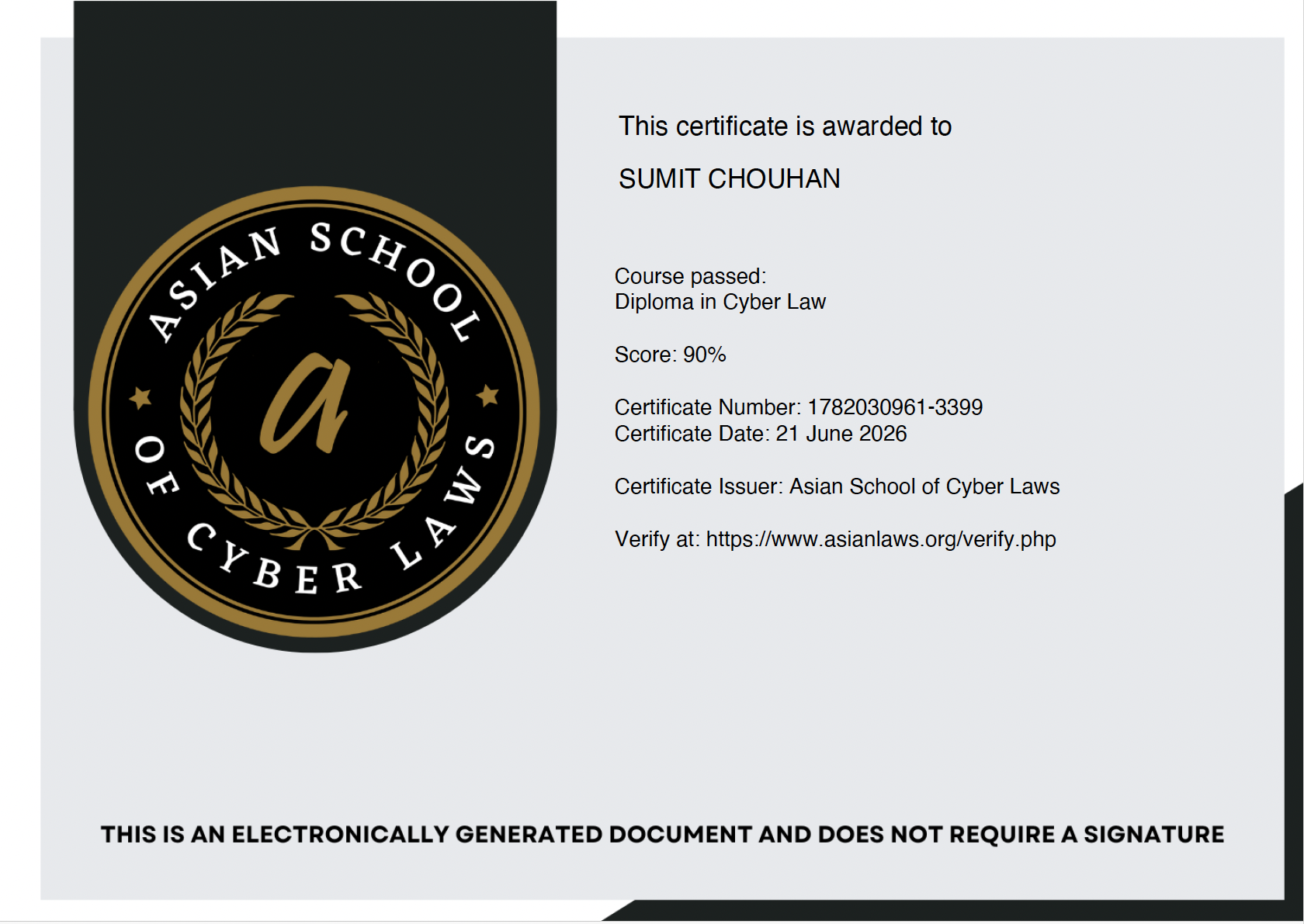
- I'm glad to share that I've completed the Diploma in Cyber Law from the Asian School of Cyber Laws, finishing with a score of 90%. It is important to know laws that govern your security posture before we talk about #V2X security. The course took me deep into the Information Technology Act, 2000 and the framework that now governs digital evidence, data protection, and cybercrime in India. A few areas that stuck with me: a. How Section 65B of the Evidence Act (now Section 63 of the Bharatiya Sakshya Adhiniyam) shapes the admissibility of electronic records, and why the certificate behind a printout matters as much as the printout itself. b. The line between civil contraventions under Section 43 and criminal offences under Sections 66 to 66F, and how intent moves an act from one to the other. c. The data protection obligations under Section 43A and the SPDI Rules, and what reasonable security practices actually demand from the organisations that hold sensitive personal data. As someone working in cybersecurity, I see the legal layer and the technical layer as one system. Knowing how the law treats access, interception, and breach makes me better at the work I already do. Thanks to the Asian School of Cyber Laws for a rigorous program. On to applying it. Plus a big thanks to everyone. #CyberLaw #Cybersecurity #InformationTechnologyAct #DataProtection #ASCL
Liked by Bhushan Chandekar
1 reactions - India’s 5.9 GHz C-V2X notification is an important step. But opening the band is only the beginning. The Department of Telecommunications has created an exemption framework for Cellular Vehicle-to-Everything communication in the 5875–5905 MHz band, with defined RF limits such as 23 dBm/MHz maximum power spectral density, 33 dBm maximum EIRP, and -30 dBm/MHz out-of-band emissions. That gives connected mobility a clearer regulatory path. But anyone who has spent serious time with RF knows one thing: A band is not “ready” just because it is available. a. It has to be measured. b. It has to be characterised. c. It has to be understood in the field. At 5.9 GHz, the physics is unforgiving. Link margins can disappear quickly. Antenna placement matters. Vehicle shadowing matters. Roadside clutter matters. Multipath, Doppler, interference, congestion, timing drift, and front-end behaviour all matter. On paper, V2X is a packet. On the road, it is a microwave signal trying to survive a very hostile channel. This is where I believe amateur radio experience becomes relevant. Amateur microwave operators around the 5.7 GHz region understand link budgets, antenna gain, feeder loss, receiver sensitivity, noise figure, frequency stability, and the small dB losses that decide whether a signal decodes or disappears. Weak-signal operators understand timing discipline, coding gain, and decoding close to the noise floor. APRS operators have lived through shared-channel congestion, over-beaconing, relay storms, and the limits of polite access protocols. Direction-finding operators understand that detecting a signal is one thing; locating the physical emitter is another. These are not abstract ideas. They are operating realities. That is why I wrote my article: Lessons From the Bands: Amateur Radio Technical Practice as a Resource for V2X Research (https://lnkd.in/gvdkPaHC) V2X should not rediscover old RF lessons the hard way. India has opened the regulatory door. Now we need to build the measurement culture around it: passive roadside sensing, open 5.9 GHz propagation data, interference mapping, congestion studies, timing-resilience experiments, and security models that connect the digital message to the physical signal. Because in V2X, trust does not begin at the packet. It begins at the channel. Check here - https://lnkd.in/g2Rn2rg4 #V2X #CV2X #ConnectedVehicles #AutomotiveCybersecurity #AmateurRadio #India
